MCA vs. Business Loan: Which Funding Fits Your Cash Flow?
Both put cash in your account fast — but they are priced, repaid and underwritten very differently. Here is how to choose with confidence.
Sep 19, 2026Read
Capital solves a timing problem. It does not solve a margin problem. Seven moments when the right answer is no — and what to do instead.
Funding is a tool for timing problems. It moves money you will have into the moment you need it. What it cannot do is fix a business that loses money on every sale, and taking capital in the wrong moment turns a difficult quarter into a structural problem. Here are the seven situations where the answer should be no — and what to do instead.
If each sale costs more to deliver than it brings in, more volume makes things worse, and borrowed money simply funds the losses faster. Run the test: gross profit per unit after all direct costs. If it is negative or razor thin, fix pricing or cost first. Capital buys time only when there is something to fix within that time.
Take your lowest revenue month in the past year and subtract fixed costs, payroll and existing debt payments. If the new payment does not fit comfortably in what remains, the deal will work until the first slow month and then stop working.
A rough guardrail used by lenders and worth borrowing: total debt service should stay under about 10% of revenue for short-term obligations, and overall debt payments should leave net operating income at 1.15–1.25 times total payments.
Adding another advance to existing daily remittances is the most reliable way to run out of operating cash. If current obligations already consume more than roughly 20% of deposits, the right move is refinancing, not more funding. See your refinancing options.
"Sales will pick up" is not a use of funds. Legitimate uses have a mechanism and a timeline: inventory that turns in 60 days, equipment that adds capacity you have already sold, a hire with a defined revenue target. If you cannot write the sentence "this money produces X by date Y", wait.
Financing a one-off tax liability can be sensible. Financing a recurring liability because the business never sets the money aside just moves the problem forward with interest attached. Fix the reserve first — a separate account and a fixed percentage of every deposit.
If your repayment plan assumes the best case — the contract renews, the season is strong, the renovation finishes on time — stress test it. Model 20% less revenue and a month of delay. If the plan fails under that, you are not borrowing, you are betting.
Owners sometimes borrow to avoid a hard call: closing a location, letting a product line go, renegotiating a lease. Capital delays the decision and adds a payment to it. Make the call first, then fund the version of the business that survives it.
Borrowing earns its cost when the money has a defined job with a measurable return inside the repayment window: a bulk purchase at a real discount, equipment that removes a bottleneck, a contract you have already won that needs working capital, or refinancing expensive debt into cheaper debt. If your situation looks like that, start with choosing the right funding path.
Yes — when the return is bigger and faster than the cost. A 1.25 factor advance that captures a 20% inventory discount you turn in 45 days can make sense. The same advance covering ordinary overheads rarely does.
There is no single number, but if total payments leave less than about 1.15 times coverage of net operating income, or short-term payments exceed 10% of revenue, you are in the zone where one bad month causes a default.
Sometimes, but keep a personal emergency reserve separate from the business. Owners who put every dollar in have no runway left when the business needs them most.
A services business is losing roughly $9,000 a month and has a new contract starting in four months worth $20,000 a month in gross profit. Borrowing $45,000 to bridge the gap is defensible — the maths works and the end date is real. The same business borrowing because "things usually pick up in spring" is not the same decision, because there is no contract, only a hope.
A $90,000 machine with a four-year financed payment of about $2,200 a month only pays for itself if it adds more than $2,200 of gross profit a month. Ask what has already been sold that the machine will produce. If the answer is "we will sell more once we have it", buy the smallest version that proves demand first.
A one-off timing gap caused by a customer paying late is a classic, legitimate use of a line or factoring. Payroll being short three months in a row is not a funding problem. It is a pricing, cost or collections problem, and borrowing against it moves the crisis forward by a quarter and adds a payment.
Declining funding when the numbers do not work keeps your file clean, your UCC record clear and your options open for the deal that does work in six months. Lenders remember borrowers who understand their own numbers, and the next conversation is usually easier because of it.
Both put cash in your account fast — but they are priced, repaid and underwritten very differently. Here is how to choose with confidence.
Most small acquisitions are funded with an SBA 7(a) loan plus a seller note. Here is how the stack works in 2026, what the new rules changed, and the other routes worth knowing.
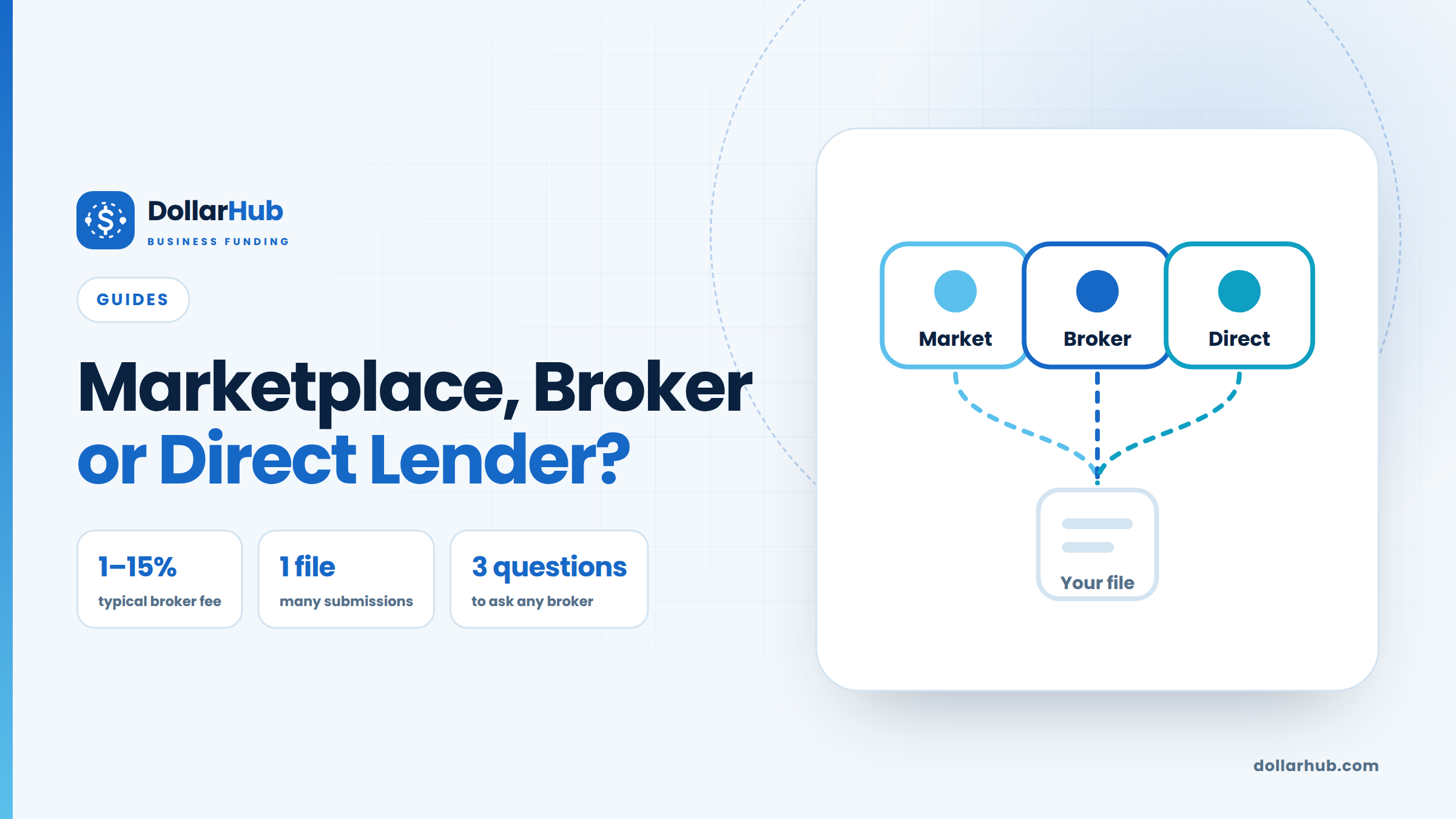
Each route has a place. The difference shows up in how your file is shopped, who gets paid, and how many hard pulls land on your credit.