MCA vs. Business Loan: Which Funding Fits Your Cash Flow?
Both put cash in your account fast — but they are priced, repaid and underwritten very differently. Here is how to choose with confidence.
Sep 19, 2026Read
Each route has a place. The difference shows up in how your file is shopped, who gets paid, and how many hard pulls land on your credit.
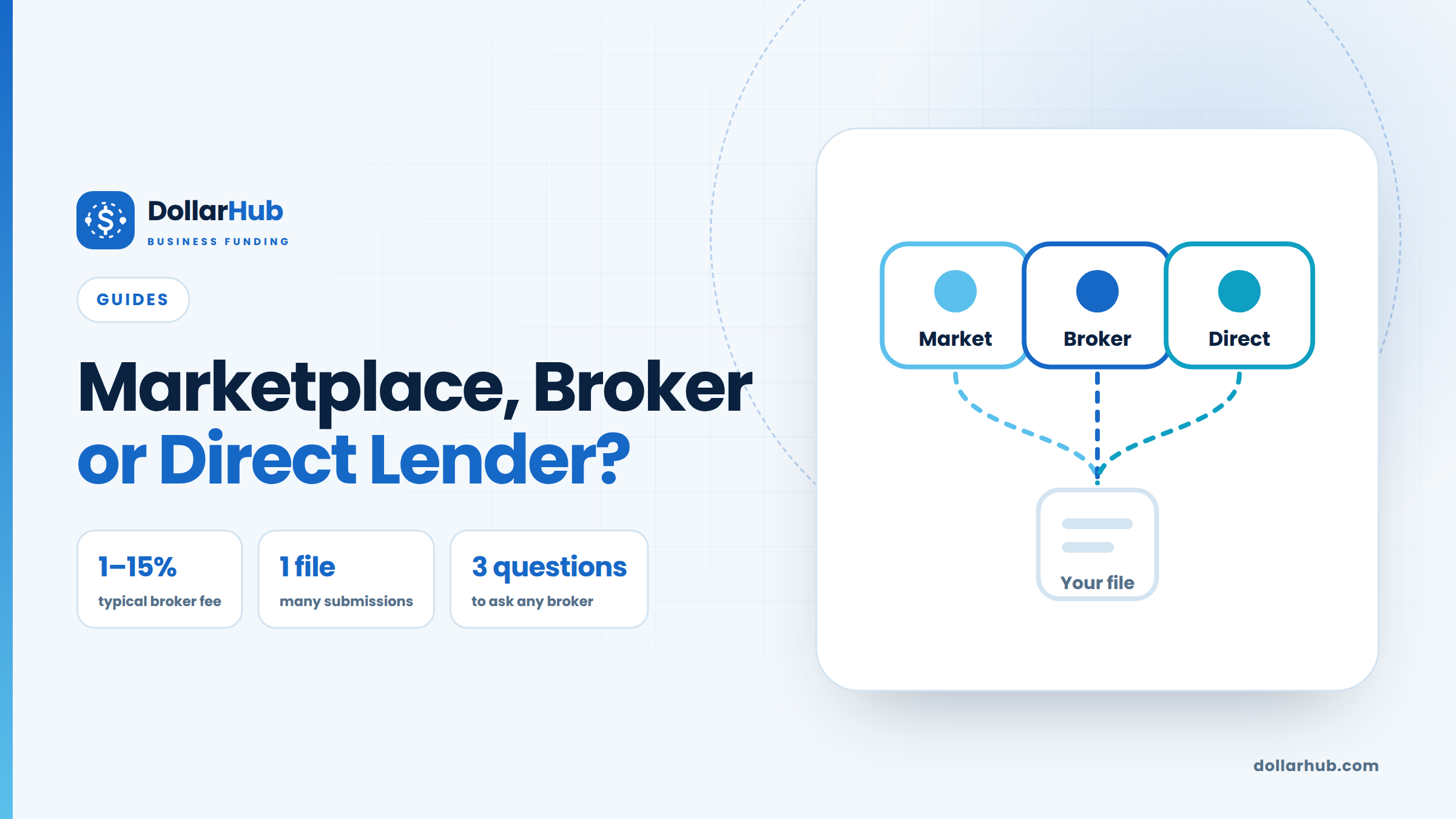
The same business file can reach a funder three ways: through a marketplace, through a broker (often called an ISO), or straight from you to a direct lender. Each route has a legitimate place. The differences that matter are who gets paid, how many times your file is shopped, and who is accountable when something goes wrong.
A company that underwrites with its own money and services the loan afterwards. One application, one credit decision, one relationship for the life of the facility.
An intermediary who takes your file and submits it to funders they work with. They are paid a commission by the funder, sometimes added to your cost, and typically know which funder likes which industry.
A platform where you complete one application and receive several offers, usually with a soft credit pull first. Marketplaces are also compensated by the lenders, but the process is more transparent and you generally see offers side by side.
| Direct lender | Broker / ISO | Marketplace | |
|---|---|---|---|
| Who underwrites | Them | A funder behind them | Partner lenders |
| Typical cost impact | No intermediary margin | Commission, sometimes 1–15% | Built into lender pricing |
| Speed | Fast if you fit their box | Fast — they know where to send it | Fast for comparison |
| Credit pulls | One | Potentially several | Usually one soft pull first |
| Best for | You know the product you need | Complex or thin files | Comparing options quickly |
You know what you need, your file is reasonably clean, and you want one accountable counterparty. Going direct also avoids the main risk of brokered deals: having your application submitted to a dozen funders at once, which looks like distress and can harden pricing.
Thin or complicated files — a restaurant with seasonal swings, a trucking company with one large customer, an owner with a past bankruptcy — are often declined by generic underwriting and approved by a specialist funder. A good broker knows which funders say yes to what, and can package the story properly. That is worth paying for.
The test is whether they will tell you, in writing: which funders they submitted to, what they are being paid, and whether the fee is inside or on top of the offer.
When you want to see the range of the market in a day without handing your file to fifteen separate companies. The trade-off is that marketplaces generally serve the mainstream credit box — if your file is unusual, you may end up back with a specialist anyway.
Start direct with one lender that clearly serves businesses like yours. In parallel, use one marketplace or one broker for comparison — not three. Make them compete on total repayment, not on who calls you most. For how to line the offers up fairly, see overwhelmed by funding options.
Sometimes, and sometimes not — a broker who finds a funder that prices your industry properly can beat the direct offer you would have found alone. What you should never accept is an undisclosed fee.
Only if they submit widely with hard pulls. Agree in advance on how many submissions are acceptable.
Look for a real business address, a state license or registration where required, a funding history you can verify, and reviews that mention servicing rather than just sales. In several states, brokers of sales-based financing must now register with the regulator.
When you hand over bank statements and an application, that package becomes a tradeable asset. A good intermediary sends it to two or three funders chosen for your industry and profile. A bad one blasts it to twenty, which has three consequences you feel directly:
Ask for a submission list before you authorise anything, and put a cap on it in writing: "Submit to no more than three funders and tell me which."
If any step is missing, ask for it. The reaction tells you most of what you need to know.
Commission on short-term products commonly runs 1–15% of the funded amount, often paid by the funder and reflected in your pricing. On SBA and bank products, packaging fees are usually a flat amount disclosed in the loan documents. What is not normal: an upfront fee before any offer exists, a fee that changes after approval, or a commission that is not written anywhere in your paperwork.
Both put cash in your account fast — but they are priced, repaid and underwritten very differently. Here is how to choose with confidence.
Most small acquisitions are funded with an SBA 7(a) loan plus a seller note. Here is how the stack works in 2026, what the new rules changed, and the other routes worth knowing.
Capital solves a timing problem. It does not solve a margin problem. Seven moments when the right answer is no — and what to do instead.