Merchant Cash Advance Guide: How MCAs Really Work
An MCA is not a loan, and a factor rate is not an interest rate. This guide shows the maths, the qualification bar and the clauses that matter before you sign.
Sep 28, 2026Read
Six real ways out of stacked advances, from a single consolidation loan to a negotiated workout — plus the warning signs of the 'debt relief' offers that make things worse.
If two or three advances are taking a slice of every day's deposits, the problem is no longer the cost of the money. It is the speed of repayment. Refinancing an MCA is about moving that burden from daily to monthly, and from a few months to a few years — without signing something that makes next quarter worse. Here are the six real options, in the order most owners should consider them.
Before you talk to anyone, write down for each advance: original amount funded, total payback, amount still owed, daily or weekly remittance, remittance frequency, and the funder's name. Add them up. The total daily debit is the number that matters — it tells you how much of every day's sales never reaches your operating account.
Then calculate what percentage of your monthly revenue is leaving as remittances. Above roughly 20%, most businesses cannot buy inventory and make payroll comfortably. Lenders will look at exactly the same ratio.
A single term loan that pays off the advances and leaves you with one monthly payment over one to five years. This is the cleanest outcome: lower total cost, far lower daily cash drain, and a clear end date.
What it takes: decent credit, consistent deposits, and generally a debt service coverage ratio of 1.15x or better after the new payment. The loan needs to be large enough to retire the balances in full.
Watch for: prepayment terms on the existing advances. Many are not discounted, so you repay the full remaining balance, not the funded amount.
SBA rules allow qualifying business debt to be refinanced, often up to 90% loan-to-value, and high-cost short-term debt is exactly the sort of thing the programme is designed to replace. Rates in late 2026 ran from 10.00% to 13.50% depending on size — a fraction of advance pricing — with terms up to 10 years for working capital.
What it takes: time (30–90 days), tax returns, financial statements, and a lender willing to look past the advances. Business acquisitions and owner buyouts now need a DSCR of 1.25x, with 1.15x for expansions.
Worth knowing: some lenders will not refinance advances taken within the last few months, and seller notes or related-party debt have their own rules.
A funder deposits money into your account on a schedule to cover your existing remittances, while you repay them on longer terms. It reduces the daily drain immediately without paying the advances off.
The trade-off: you now owe both the original advances and the reverse consolidation. Total cost usually rises. It can buy breathing room for a business with a clear seasonal recovery ahead; it is dangerous as a way to delay a structural problem.
Underused and often effective. Funders would rather restructure than chase a defaulted balance. Ask for a reduced daily remittance for a defined period, a switch from daily to weekly, or a discounted lump-sum payoff if you can raise part of the balance elsewhere.
Put the request in writing, attach recent bank statements showing the strain, and propose a specific number rather than asking what they can do.
If your cash is tied up in receivables or equipment, invoice factoring, an equipment sale-leaseback or a line of credit secured by assets can generate the money to clear advances at a much lower cost. This works especially well for B2B businesses with net-30 to net-90 customers.
If remittances are already bouncing, talk to a commercial attorney before you sign anything else. Workouts negotiate reduced balances or payment plans across multiple funders. It is a last resort and it has consequences — including UCC filings, possible default judgments and damaged funder relationships — but it is better than default by surprise.
Sometimes. Asset-backed options — factoring, equipment refinancing — care more about the asset than your score. Unsecured consolidation generally needs 600+, and SBA lenders are typically comfortable from about 650–680.
Applications may cause inquiries, and a new loan adds to reported debt. Compare that with the alternative: missed remittances, NSF fees and a possible default, all of which do far more damage.
Private consolidation loans commonly fund in 3–10 business days. An SBA refinance takes 30–90 days, so start it before the pressure becomes acute.
Usually yes, unless the agreement contains a prepayment discount. Always request a written payoff letter — a few funders will negotiate a reduction for immediate payment.
Suppose three advances take a combined $780 a day — about $16,400 a month — against $70,000 of monthly deposits. That is 23% of revenue leaving before any bill is paid. A consolidation loan of $120,000 over 36 months at 18% costs roughly $4,340 a month. Same debt, same business, with about $12,000 a month returned to operations.
That is why consolidation is worth pursuing even at a double-digit rate. The rate is not what is hurting you; the speed of repayment is.
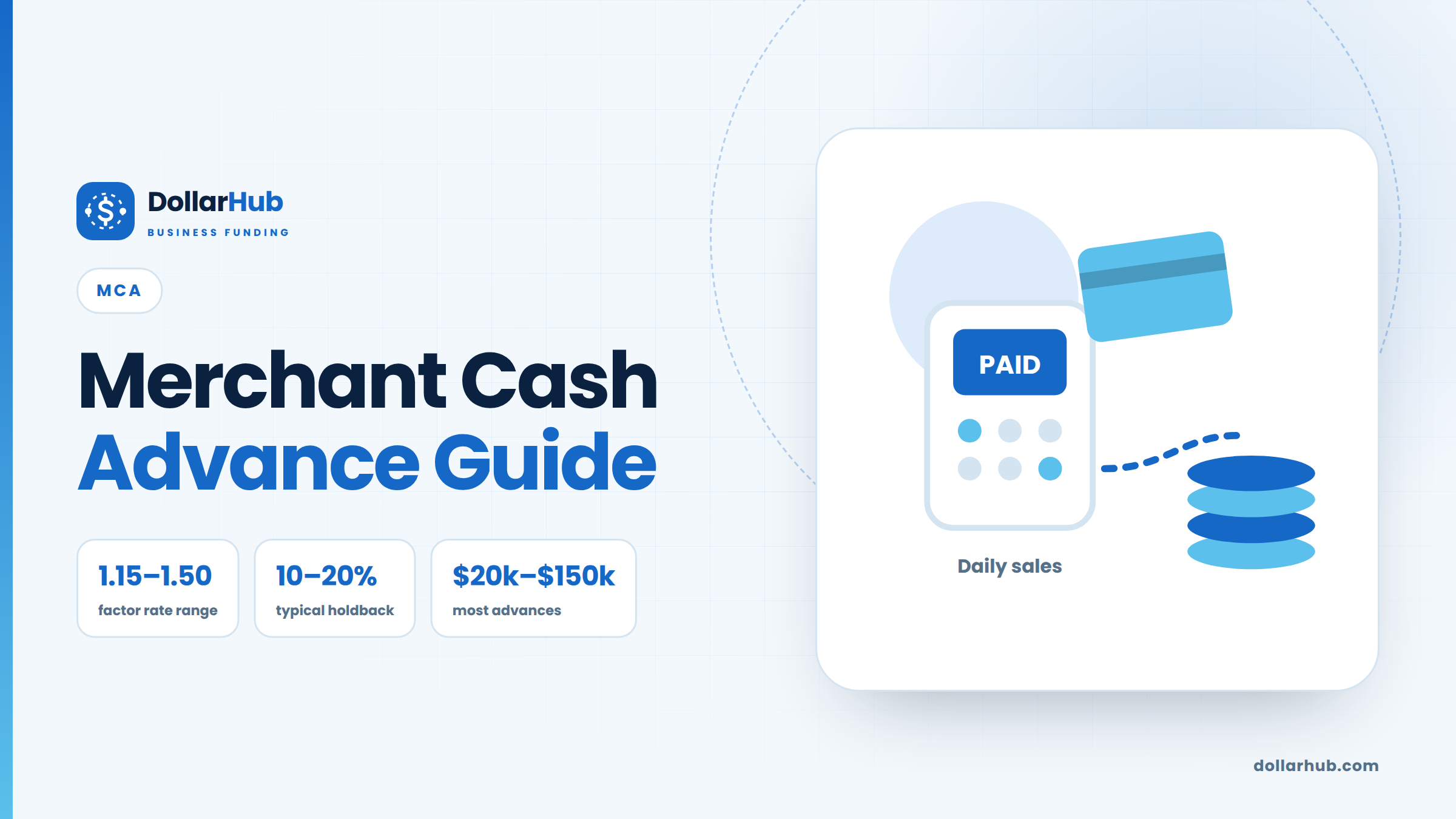
An MCA is not a loan, and a factor rate is not an interest rate. This guide shows the maths, the qualification bar and the clauses that matter before you sign.
A factor rate is not an interest rate. Here is how to turn it into a number you can actually compare.
Taking several advances at once can squeeze daily cash flow. Consider these alternatives first.