MCA vs. Business Loan: Which Funding Fits Your Cash Flow?
Both put cash in your account fast — but they are priced, repaid and underwritten very differently. Here is how to choose with confidence.
Sep 19, 2026Read
Purpose, speed, cost and repayment shape. Answer four questions and the list of twelve products becomes a shortlist of two.
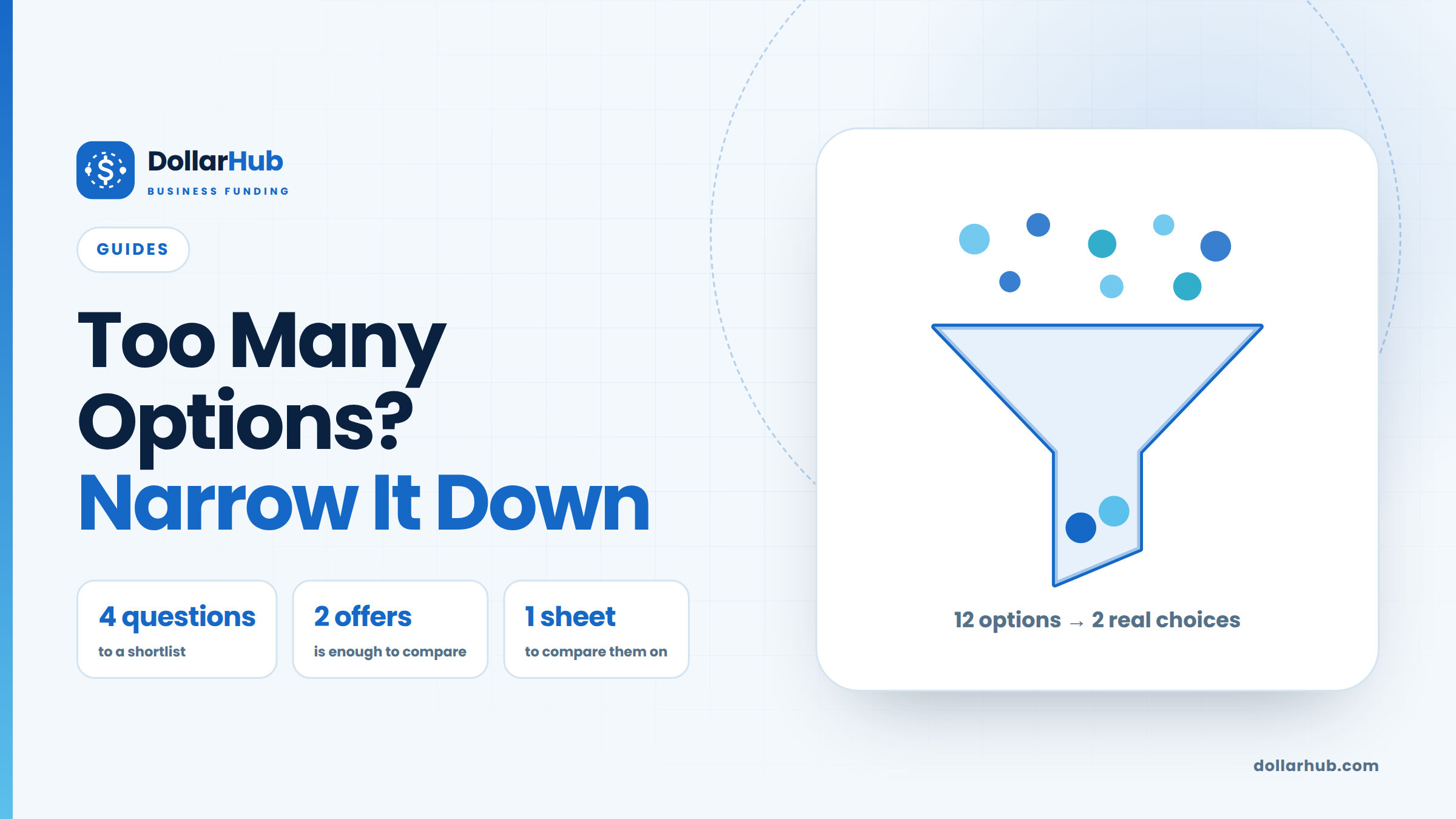
A dozen products, forty lenders, three brokers calling a day and an inbox full of pre-approvals that are not really approvals. The paralysis is reasonable. Here is a short framework that turns the whole market into a shortlist of two in about ten minutes.
Business funding has no standard unit of price. One offer quotes a factor rate, another an APR, a third a monthly fee and a fourth "a dollar a day". They are deliberately hard to compare, and most of the marketing is written to create urgency rather than clarity.
The fix is to stop comparing offers and start filtering products. Products are few; offers are many.
This single answer eliminates most of the market.
| Purpose | Products that fit |
|---|---|
| Buying a machine, vehicle or equipment | Equipment financing or lease |
| Buying or refinancing property | SBA 504, conventional mortgage, DSCR loan |
| Buying another business | SBA 7(a) plus seller note |
| Covering slow months or payroll gaps | Line of credit, invoice factoring |
| Inventory or a short, time-boxed opportunity | Line of credit, short-term loan, MCA |
| Refinancing expensive debt | SBA 7(a), consolidation term loan |
Be honest about the deadline. "This week" and "this quarter" lead to completely different products, and speed is the single most expensive feature in business funding.
If the deadline is artificial — created by a lender's "expiring offer" rather than by your business — take the extra week.
Take your lowest revenue month in the last year. Subtract fixed costs, payroll and existing debt payments. Whatever is left, use no more than half of it for a new payment. That number is your real budget, and it is more useful than any approval amount.
For daily-remittance products, convert: a 12% holdback on $40,000 of monthly card sales is roughly $4,800 a month, every month, whether or not it was a good month.
Once two products survive, request offers and compare them on exactly these columns:
| Column | Why it matters |
|---|---|
| Amount funded (after fees) | What actually arrives in your account |
| Total repayment | The real price |
| Payment and frequency | What your cash flow feels |
| Term or estimated payoff | How long you are committed |
| Prepayment terms | Whether paying early saves money |
| Collateral and guarantees | What is at risk |
Two offers are enough. A third rarely changes the decision and costs you another credit inquiry.
Comparing two or three is healthy. Having five pull your file in a week is not.
Convert the factor to total dollars repaid, divide by the amount funded, then annualize over the estimated payoff period. A 1.30 factor repaid in six months is roughly 60% annualized; the same factor over twelve months is roughly half that.
Take the cheapest one that fits the purpose and the timeline. Keep the second option open as a backup facility rather than drawing on both.
Shortlist: equipment financing (fits the asset, 2–5 year term, roughly $400–$500 a month) and, if the equipment lender cannot fund in time, a small advance repaid quickly. The right answer here is equipment financing, with the advance as a fallback only if downtime costs more than the extra interest.
Shortlist: invoice factoring or a receivables-backed line of credit. A term loan would be repaid on a fixed schedule unrelated to when customers pay, and an advance would take daily debits against revenue that arrives in lumps. The structure has to match the cash cycle, not just the amount.
If a line of credit and a term loan both fit, choose by certainty: if the amount and timing are known, take the term loan for the lower rate. If either is uncertain, take the line and only pay for what you use. If a line and an advance are close on cost, take the line every time — flexibility is free, speed is not.
The best time to arrange funding is a quarter before you need it. Offers made to a business with cash in the bank are cheaper than offers made to a business that has run out, and the paperwork is identical. If you are reading this with no immediate need, that is the ideal moment to set up a facility you may never draw.
Both put cash in your account fast — but they are priced, repaid and underwritten very differently. Here is how to choose with confidence.
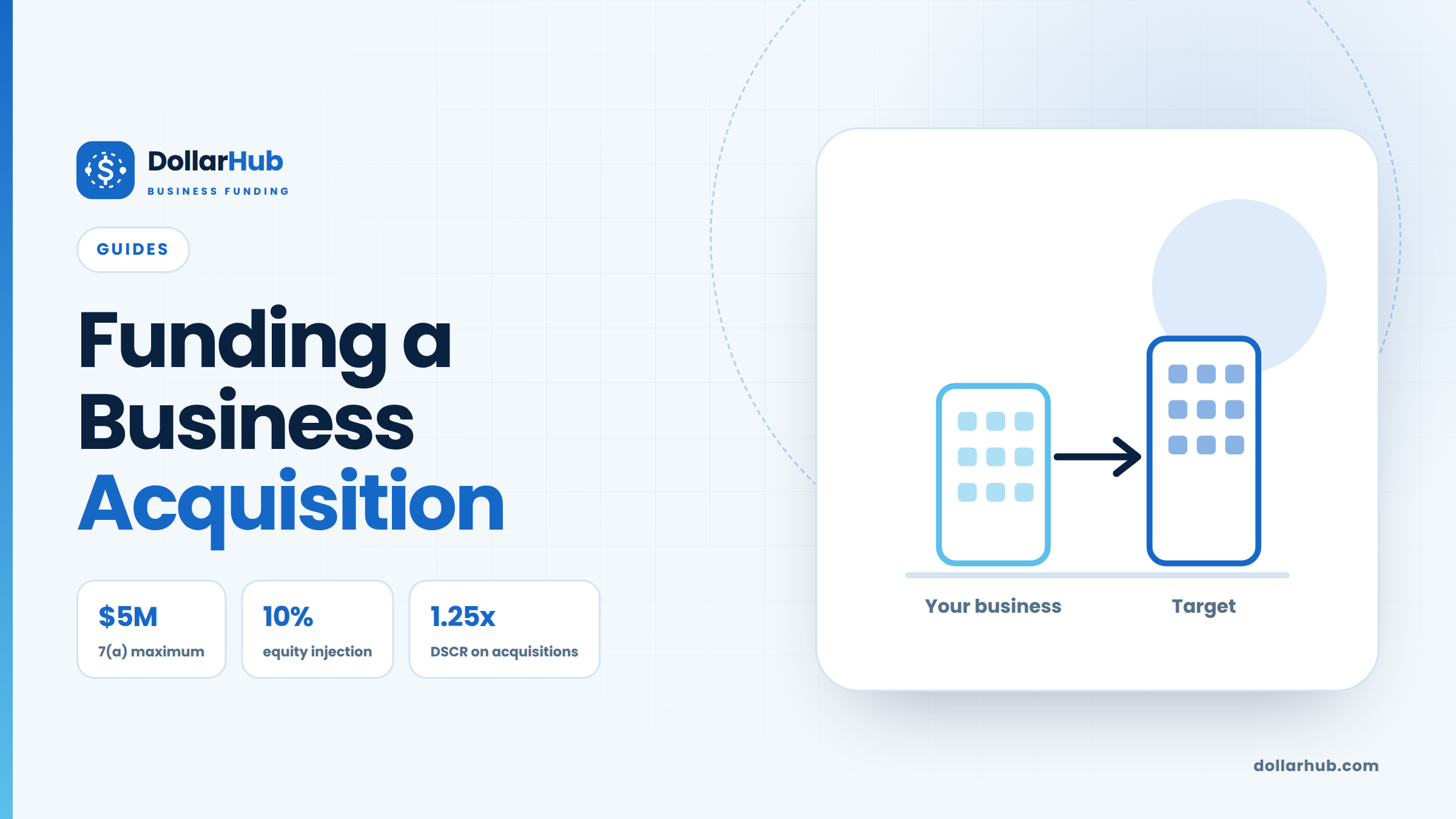
Most small acquisitions are funded with an SBA 7(a) loan plus a seller note. Here is how the stack works in 2026, what the new rules changed, and the other routes worth knowing.
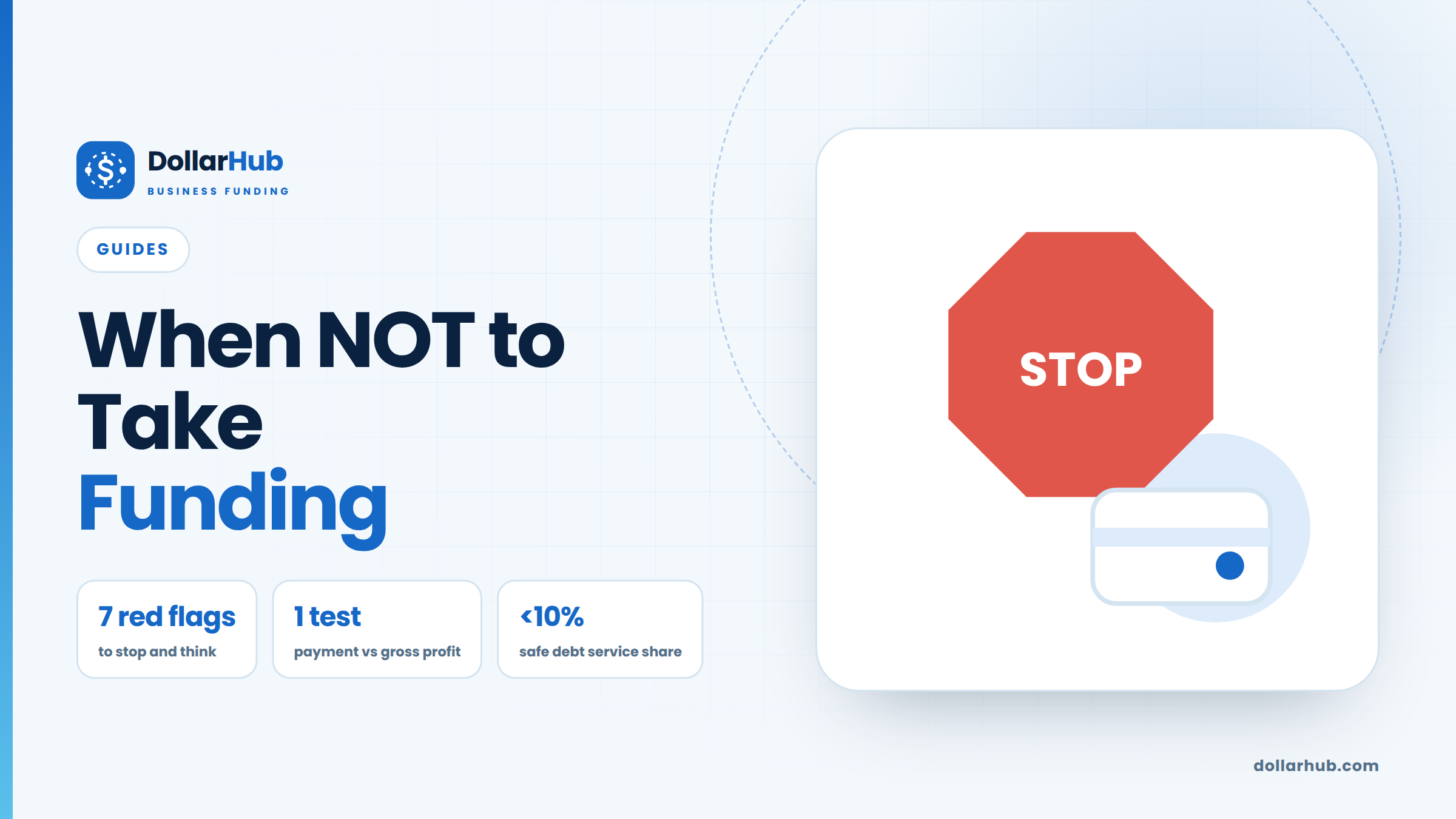
Capital solves a timing problem. It does not solve a margin problem. Seven moments when the right answer is no — and what to do instead.