7 Steps to Manage Seasonal Business Cash Flow
Seasonal business cash flow gets tight in slow months. Learn how to build a 12-month forecast, set cash reserves and plan financing before the gap hits.
Nov 1, 2026Read
Learn how to get a business loan with bad credit, from checking lender requirements to preparing documents and comparing alternatives before you apply.

Last Updated: October 30, 2026
Quick Summary
A business loan with bad credit is possible, though lenders typically charge more and set stricter terms. Requirements vary, but personal credit scores below 630 can make traditional bank loans difficult to obtain, so alternatives such as lines of credit may fit better.
A low credit score does not automatically rule out business financing, but it does shape which lenders will say yes and what they will charge. Bankrate's 2026 guide says borrowers with a FICO score under 630 may find business loans difficult to obtain, though not impossible (Bankrate's 2026 bad-credit business loan guide). Small Business Administration takes a similar view, noting that even applicants with bad credit may qualify for startup funding, and it advises checking each lender's full eligibility requirements (SBA guidance on funding a small business with SBA loans).
DollarHub's AI guidance system helps owners identify a funding option that fits their situation.
Requirements vary widely. A 2026 Forbes Advisor guide reports that some lenders accept personal credit scores as low as 500, while a score of at least 670 is typically needed for the most competitive rates (Forbes Advisor's 2026 small-business loan guide).
The practical takeaway: the lower your score, the more you should expect to look at alternative products rather than traditional bank term loans. Ask each lender for its stated minimum before you apply.
Lenders look past your score. They also weigh how long you have operated, how much you earn, and whether cash flow covers repayments. A business with steady monthly deposits often gets a closer look than the score alone would suggest.
Pull together 12 months of revenue and your current average daily balance before you talk to any lender. Those two numbers show which products you can realistically qualify for.
Most lenders ask for the same core records. Having them ready shortens approval time and signals your books are in order, which matters more when your credit is weak. The real value is understanding what each document assesses, so you can fix problems before an underwriter finds them.

Use this as a document-by-document plan. For each item, the right-hand column explains what the lender is actually evaluating.
If your books are messy, you are not out of the running. Reconcile bank accounts, categorize the last few months of transactions, and be ready to explain large deposits or gaps. A clear explanation often works better than a perfect file.
A few patterns worth addressing in advance:
DollarHub's three-step application keeps the document request focused, so you are not sending years of records you do not need. Start with the checklist above, and you will walk into any lender conversation with a file that answers questions before they are asked.
The checklist below summarises what each core document tells a lender, so you can spot and fix problems before underwriting.
| Document | Typical period | What the lender evaluates |
|---|---|---|
| Business bank statements | Three to six months | Average daily balance and deposit consistency |
| Business tax returns | One to two years | Reported revenue and net income against bank records |
| Profit-and-loss statement and balance sheet | Current period | Gross margin, existing debt, and debt-service coverage |
| Debt schedule | All current debts | Total obligations and monthly payments |
| Government-issued ID | Each owner of 20% or more | Identity verification and beneficial ownership |
| Business plan or use-of-funds summary | Current | Specific use of funds and how it generates repayment |
| Licenses, leases and contracts | Current | Legal operation and ongoing obligations |
| Accounts receivable and payable aging reports | Current | How quickly receivables convert to cash |
A business line of credit lets you draw funds as needed and repay as you go.
Credit Suite
Lines of credit can suit businesses that need working capital in short bursts. Ask each provider how interest and fees are calculated. Compare draw fees, the interest rate, and annual maintenance charges before you accept.
Watch out: A line of credit is easy to overuse. Draw only what you can repay within your next sales cycle.
If a traditional bank loan is out of reach, several other products may fit. A 2026 Lendio guide identifies invoice factoring, equipment financing, revenue-based financing, and microloans as common options that may accept borrowers with weaker credit (Lendio's 2026 guide to bad-credit business financing).
DollarHub offers business term loans and merchant cash advances. Each product has a different cost structure. Compare the total repayment amount, not just the monthly figure.
The right alternative depends on what the money is for. Use this decision guide before you apply:
Bad-credit products often quote cost in ways that are hard to compare. Before you sign, convert every offer to the same measures:
Keep in mind:
A denial is information, not a dead end. Ask the lender for specific reasons in writing, address the weakest item first (often cash flow documentation or a credit-report error), and avoid a burst of applications to multiple lenders in a short window. Space applications out, fix what you can, and choose a product that matches your actual need rather than the first offer that appears.
Prequalifying lets you see likely options without a hard credit pull that could lower your score further. Use it to compare offers side by side, including total cost and repayment schedule.
Before you commit, check the total repayment amount, prepayment terms, and whether the payment schedule fits your slowest months. DollarHub provides clear total costs upfront, and select term loans carry no prepayment penalty.
Yes, but it is harder. A low credit score can make business loans harder to obtain, but financing is not always out of reach. Check each lender's published eligibility requirements before applying.
Lenders typically ask for business bank statements, financial statements, accounting records, tax documents, and proof of business ownership and time in operation. Business loan application documents help a lender judge cash flow and repayment ability, which can offset a weaker credit history. Keep your records current and organized before you apply, since incomplete paperwork is a common reason applications stall.
Requirements vary by lender and loan type. A 2026 guide from Forbes Advisor reports that some lenders allow personal credit scores as low as 500, while 670 or higher is typically needed for the most competitive rates. A 2026 SBA-focused guide says personal credit scores generally need to be 650 or higher for basic SBA loan qualification. Check the specific lender's published requirements instead of relying on a single number.
Other providers offer alternatives such as invoice factoring, equipment financing, revenue-based financing, and microloans. Each works differently, so review the terms of any option carefully. Compare total repayment cost and monthly payments for each option before choosing one.
Apply now Add dollarhub.com as a preferred source on Google →

Seasonal business cash flow gets tight in slow months. Learn how to build a 12-month forecast, set cash reserves and plan financing before the gap hits.

Fast business term loans online can fund in 24 to 48 hours, but cost and terms vary widely. Compare rates, fees, and requirements before you apply.
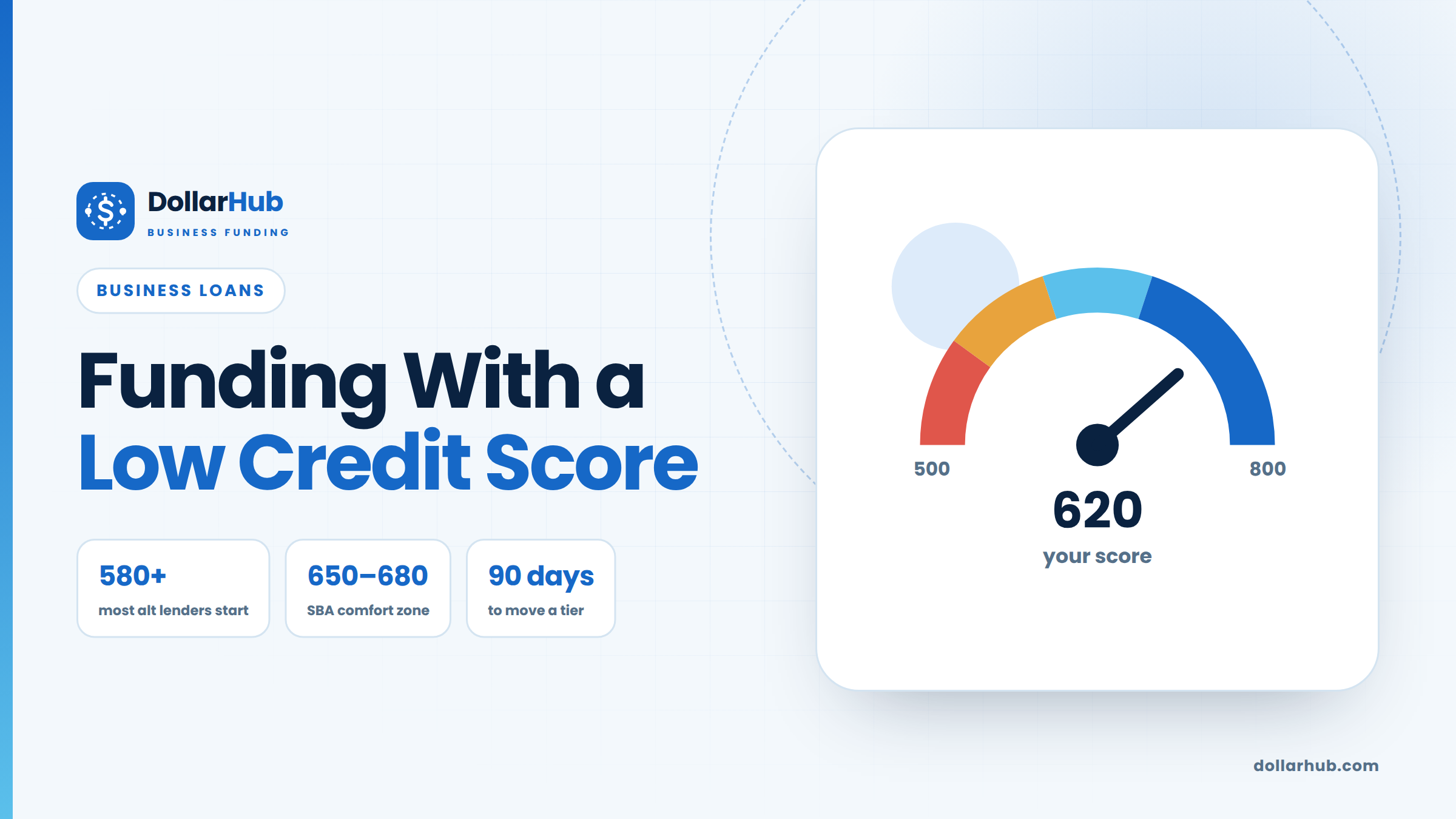
Credit score sets the menu, not the verdict. Here is what each band can realistically get, what it costs, and how to move up one tier in about 90 days.