How to Get a Business Loan With Bad Credit: 7 Steps
Learn how to get a business loan with bad credit, from checking lender requirements to preparing documents and comparing alternatives before you apply.
Oct 30, 2026Read
Seasonal business cash flow gets tight in slow months. Learn how to build a 12-month forecast, set cash reserves and plan financing before the gap hits.

Last Updated: November 1, 2026
Quick Summary
Map your seasonal business cash flow by tracking 24 to 36 months of sales and expenses, then build a rolling 12-month forecast with three scenarios. Set aside peak-season profit as a cash reserve to cover slow months.
Seasonal businesses often feel cash poor in the slow months and cash rich in the busy ones, but few track the pattern in detail.
Seasonal business cash flow is the timing gap between when money enters your business and when bills come due.
To map your pattern, pull the last 24 to 36 months of sales and expense data. Look for:
Plot these on a simple monthly grid. The gaps between income and outflow show you exactly where you need cushion.
A cash flow forecast projects money in and money out for the next 12 months, month by month. It turns your historical pattern into a plan you can act on. Most owners stop at a single "expected" column, the stronger move is to build a rolling forecast with three scenarios and defined triggers, so you know what you'll do before a shortfall arrives.

Here is a simple illustrative retail example for a shop whose busy season runs November-December and whose slow stretch runs January-March.
| Month | Cash in | Cash out | Net | Ending balance |
|---|---|---|---|---|
| Oct | $18,000 | $14,000 | +$4,000 | $14,000 |
| Nov | $42,000 | $26,000 | +$16,000 | $30,000 |
| Dec | $48,000 | $30,000 | +$18,000 | $48,000 |
| Jan | $12,000 | $9,000 | +$3,000 | $51,000 |
| Feb | $9,000 | $8,000 | +$1,000 | $52,000 |
| Mar | $10,000 | $9,000 | +$1,000 | $53,000 |
Notice the assumptions baked into each column: cash in reflects when customers actually pay (not when they buy), and cash out reflects when bills are due (not when the cost was incurred). A sale on December 28 that a customer pays in January belongs in January's cash-in row.
Build three versions of the same 12-month grid:
If the downside scenario still leaves you with a positive ending balance in every month, you have real room to plan. If it doesn't, you've found the shortfall before it hits, and you can act on it while you still have options.
A forecast only helps if it changes your behavior. Define triggers in advance so decisions aren't made in a panic:
Write the triggers down and review them at the same monthly meeting where you update the forecast. The point is to make the decision once, calmly, rather than every week under pressure.
Update the forecast monthly. Replace projections with actual results, then extend the horizon by one month so you always have 12 months ahead. Note which assumptions were wrong, collections slower than expected, a supplier price increase, a promotion that underperformed, and fix them in the next version. Over a few seasons, your forecasts will get noticeably more accurate, and the triggers will fire earlier and less often.
A simple template saves time and keeps your numbers consistent. A basic one needs just a few rows and twelve columns:
Carry each month's ending balance into the next month's starting balance. If any month drops below zero, you have found a cash shortfall to solve before it arrives. Free spreadsheet templates work well, and many accounting software tools include forecasting features. Build the three-scenario version alongside the base template so you can flip between them without rebuilding the grid each time.
Peak-season profit is not all yours to spend.
Many business advisors suggest setting aside a set share of peak-season profits each month. The exact share depends on how long your slow season runs and how large your fixed costs are.
Keep reserves in a separate savings account so they are less tempting to spend. Automate the transfer on each payday or sales deposit, so saving happens without a decision each time.
When revenue drops, expenses need to follow. Review every recurring cost and ask whether it can flex with sales.
Practical steps include:
Timing matters as much as amount. Paying a supplier after you collect from customers can close a short gap without any borrowing at all.
Sometimes reserves and cost cuts are not enough to cover a shortfall. In that case, financing can bridge the gap, but each option carries different trade-offs in timing, cost, eligibility, and risk. The right choice depends less on the headline rate and more on when you need the money, how long you need it, and what you can repay if the season comes in soft.
| Option | Best for | Cost pattern | Eligibility | Key risk |
|---|---|---|---|---|
| Business line of credit | Unpredictable gaps; draw only what you need | Interest only on drawn amount | Established revenue, decent credit | Renewal or rate reset |
| Term loan | Planned investments or a known shortfall | Fixed payments over a set term | Stronger credit and financials | Fixed payments continue in slow months |
| Invoice financing | Slow-paying customers with strong invoices | Fee or discount on each invoice | Quality receivables | Customer concentration; cost adds up |
| Merchant cash advance | Very short gaps tied to card sales | Repaid from a share of daily sales | Card sales volume | Often the highest total cost |
Compare the total cost of each option, not just the monthly payment. Ask for the full repayment amount and check for prepayment penalties.
Watch Out Avoid using short-term financing to cover a structural gap, a shortfall that appears every year and isn't closing. Financing buys time; it doesn't fix a business model where slow-season costs exceed slow-season revenue. Pair any borrowing with the cost controls and reserve-building covered above.For a closer look at weighing quick online loans against slower bank options, see Are Fast Business Term Loans Online Worth It in 2026?. If your credit profile is weaker, how to get a business loan with bad credit in seven steps walks through what lenders typically review.
Research on seasonal small businesses supports planning ahead. A 2025 paper by A. Busila outlines five strategies seasonal businesses can use to manage cash flow during the busy season for use in the slow season (Thriving Through Seasonal Cash Flow Challenges: Strategies for Seasonal Small Businesses).
Cash management works best as a routine, not a one-time project. Schedule a review at the end of each month and a deeper one before your busy season starts.
During each review, compare actual results against your forecast, update the next twelve months, and check that reserves are on track. Note which assumptions were wrong and fix them. Over a few seasons, your forecasts will get noticeably more accurate.
Start by setting aside part of your peak-season profit before the slow period begins, then cut discretionary spending and review your fixed costs. Track cash weekly rather than monthly so you spot shortfalls early. Negotiate payment terms with suppliers where possible, and keep a clear list of the bills due each month. A forecast showing your expected inflows and outflows for the next 12 months makes it easier to see exactly when the gap will open and how large it will be.
There is no single figure that fits every business, because the right reserve depends on how long your slow period lasts and how large your fixed costs are. A practical approach is to calculate your monthly fixed expenses for the slowest months, then decide how many of those months you want to cover. Review the number each quarter as your forecast changes. Keeping the reserve in a separate savings account makes it easier to leave it untouched during the off-season.
Common options include short-term business loans, lines of credit, and merchant cash advances, each with different cost structures and repayment patterns. A fixed-payment loan gives predictable costs but may strain cash during slow months. Revenue-linked repayment can ease off on slow days but often carries a higher total cost. Compare the total cost, the repayment schedule, and whether any prepayment penalties apply before you commit. DollarHub's AI guidance tool can help you narrow down options, and you can find current terms on DollarHub's website.
The most frequent mistake is spending peak-season profit as if it will keep coming in. Other common errors include forecasting only one month ahead, ignoring the timing of payroll and supplier payments, and relying on a single credit source without a backup plan. Many owners also forget to account for tax payments and owner draws in their projections. Building a 12-month forecast and reviewing it monthly helps catch these issues before they become urgent.
Managing a seasonal business takes planning, but it gets easier with a clear map, a current forecast, and a reserve that carries you through the slow months. Start with your pattern this week, and use DollarHub's AI guidance to match financing to your cash flow if you need it. Apply now to see your options.
Apply now Add dollarhub.com as a preferred source on Google →

Learn how to get a business loan with bad credit, from checking lender requirements to preparing documents and comparing alternatives before you apply.

Fast business term loans online can fund in 24 to 48 hours, but cost and terms vary widely. Compare rates, fees, and requirements before you apply.
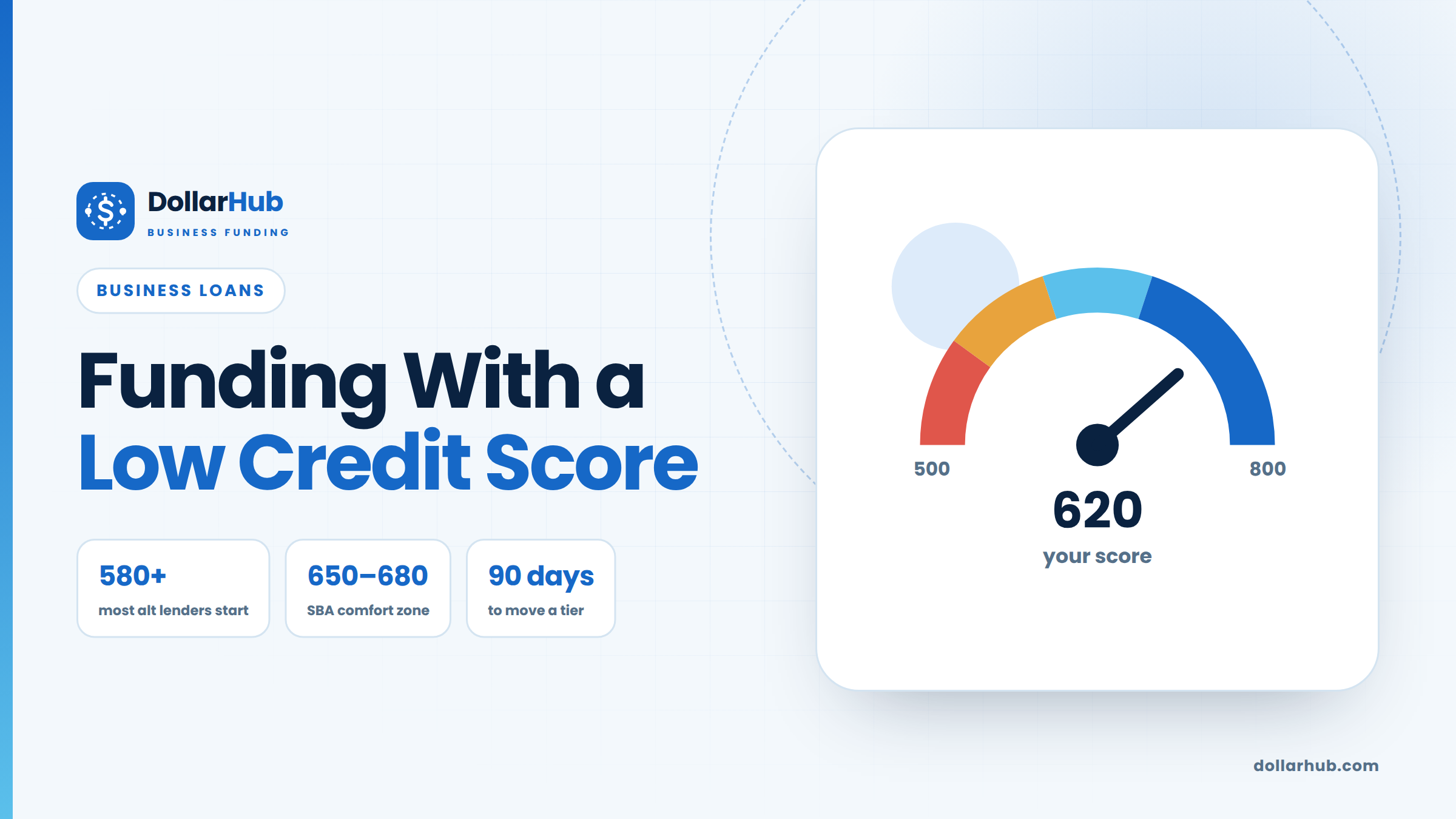
Credit score sets the menu, not the verdict. Here is what each band can realistically get, what it costs, and how to move up one tier in about 90 days.