MCA vs. Business Loan: Which Funding Fits Your Cash Flow?
Both put cash in your account fast — but they are priced, repaid and underwritten very differently. Here is how to choose with confidence.
Sep 19, 2026Read
A smaller offer is usually a maths problem, not a rejection. Here is what drove the cap, how to raise it, and how to fill the gap without wrecking your cash flow.
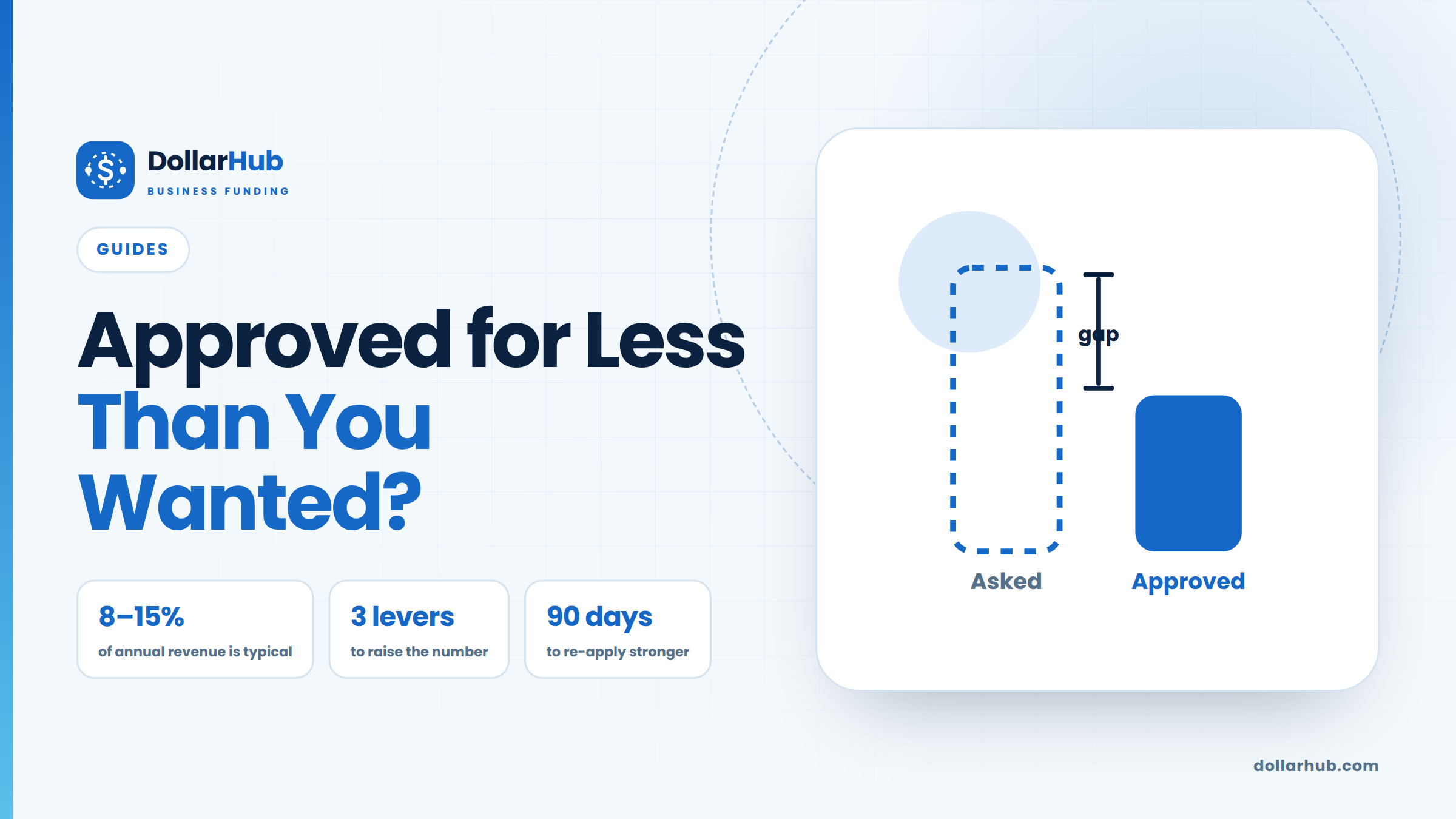
You asked for $250,000 and the approval came back at $90,000. That is frustrating, but it is useful information: a lender has told you exactly what your current file supports. Here is why the number came out where it did, how to raise it, and how to cover the gap without doing damage.
Approval size is rarely about how much you need. It is about what your business can repay from the revenue a lender can verify.
Call the underwriter or your rep and ask directly: "What would have to be true for this to be $200,000?" You will usually get a specific answer — more time in business, fewer negative days, lower existing debits, or a year of tax returns. That sentence is your roadmap.
Equipment, real estate, or receivables can move a request from cash-flow-limited to asset-limited. A $90,000 unsecured offer and a $250,000 equipment-secured facility are different products, not different moods.
Many lenders run two programmes: an "application-only" fast lane with low limits, and a full-documentation programme with far higher ones. Supplying tax returns, a year-to-date P&L and a balance sheet often doubles what is available.
A creditworthy partner on the guarantee, or stretching the term from 12 months to 36, both reduce the payment, which is the number limiting you in the first place.
Split the request into what the money does. If $250,000 was a building renovation, $90,000 may fund the phase that generates revenue first. Phasing has a hidden benefit: paying down a facility cleanly for six months is the best possible argument for a bigger second approval.
| Approach | When it works | Risk |
|---|---|---|
| Phase the project | Spend is divisible | Slower timeline |
| Add a second, different product (e.g. equipment finance alongside a line) | Separate collateral, separate repayment source | Manageable if payments are monthly |
| Vendor or supplier terms | Suppliers want the order | Low — often free |
| Stacking a second advance on the same daily revenue | Almost never | High — the fastest route to a cash crunch |
Re-applying with the same file produces the same answer. Re-applying after a quarter of clean statements, zero NSFs, lower existing debits and a higher average balance often produces a materially different one. The practical steps are in 10 things you can do to increase your chances of getting funded.
If the smaller amount still does a useful job and the terms are fair, taking it and repaying well builds a track record. If it does not solve the problem, taking it just adds a payment — keep the file and improve it instead.
No. Declining is normal. Tell them why, and ask them to re-review when a specific condition changes.
Most lenders will look again after 60–90 days, or sooner if something concrete changed — a new contract, a paid-off obligation, filed tax returns.
Not necessarily. Amount is driven mainly by verified cash flow and existing obligations. Plenty of 700+ borrowers get capped simply because their deposits do not support more.
A distribution business asks for $250,000 to buy inventory ahead of its busy season. The file shows:
The lender's unsecured programme offers up to 12% of annual revenue, which is about $89,000. Existing debt consumes roughly 4.5% of deposits, trimming the number further, and 19 months in business keeps the file out of the higher-limit programme that opens at 24 months. The $90,000 offer was not a judgement on the business — it was three policy limits stacking up.
The same business, six months later, with 25 months of trading, the short-term loan repaid, no NSFs and tax returns supplied, was offered $185,000 on a full-documentation programme at a lower rate. Nothing changed about the opportunity. The file changed.
When you go back to a lender, make it easy for them to say yes. Keep it to five lines:
Hi [name] — following up on our application from [month]. Since then: the $2,800/month obligation is paid off, we have had zero NSFs for 90 days, average daily balance is up from $6,400 to $14,900, and 2025 tax returns are attached. Revenue over the last three months averaged $71,000. We would like to revisit the $185,000 request. Happy to send anything else you need.
Specific, verifiable changes. No story, no pressure — just the three or four numbers an underwriter has to re-key anyway.
Both put cash in your account fast — but they are priced, repaid and underwritten very differently. Here is how to choose with confidence.
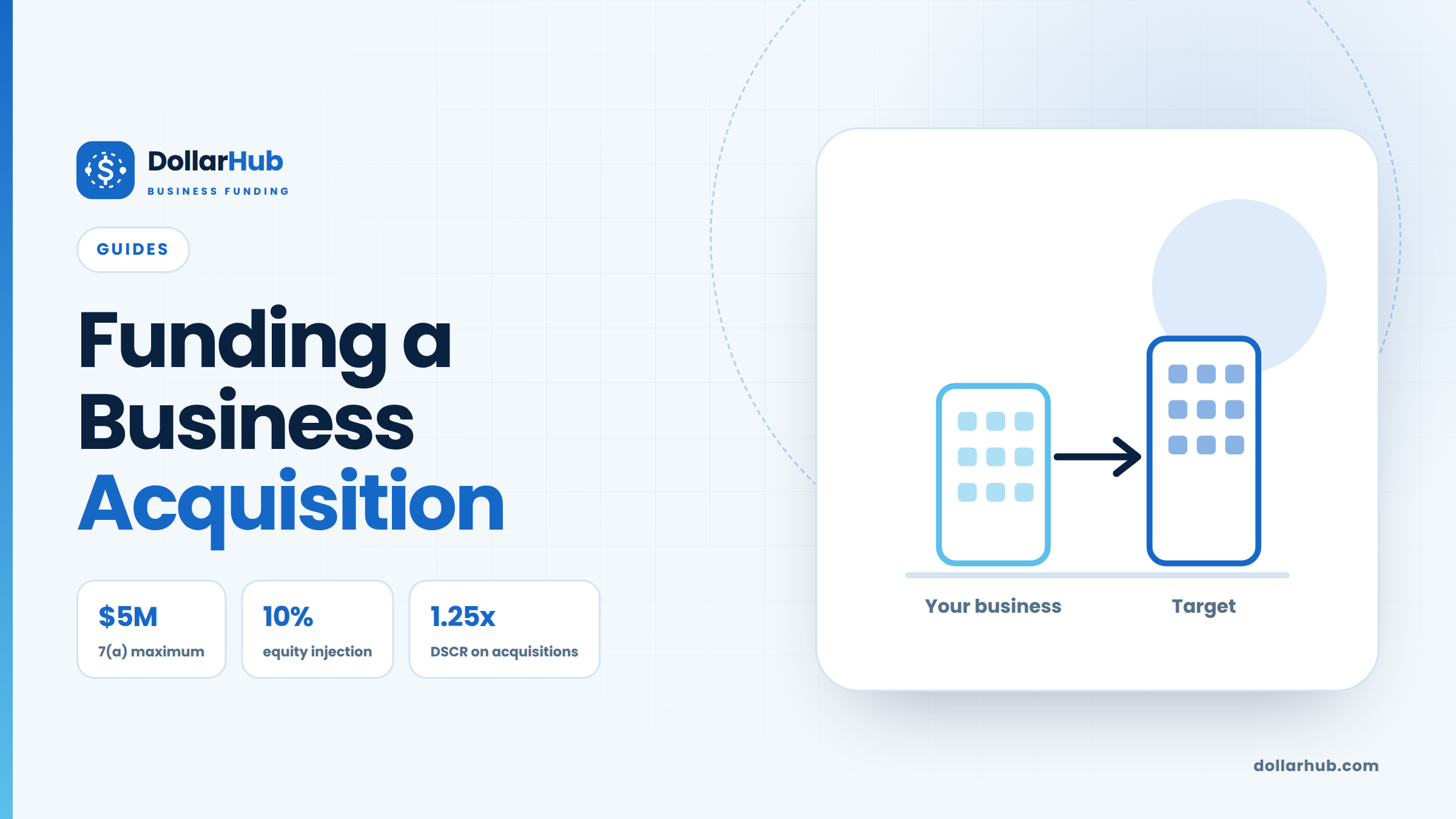
Most small acquisitions are funded with an SBA 7(a) loan plus a seller note. Here is how the stack works in 2026, what the new rules changed, and the other routes worth knowing.
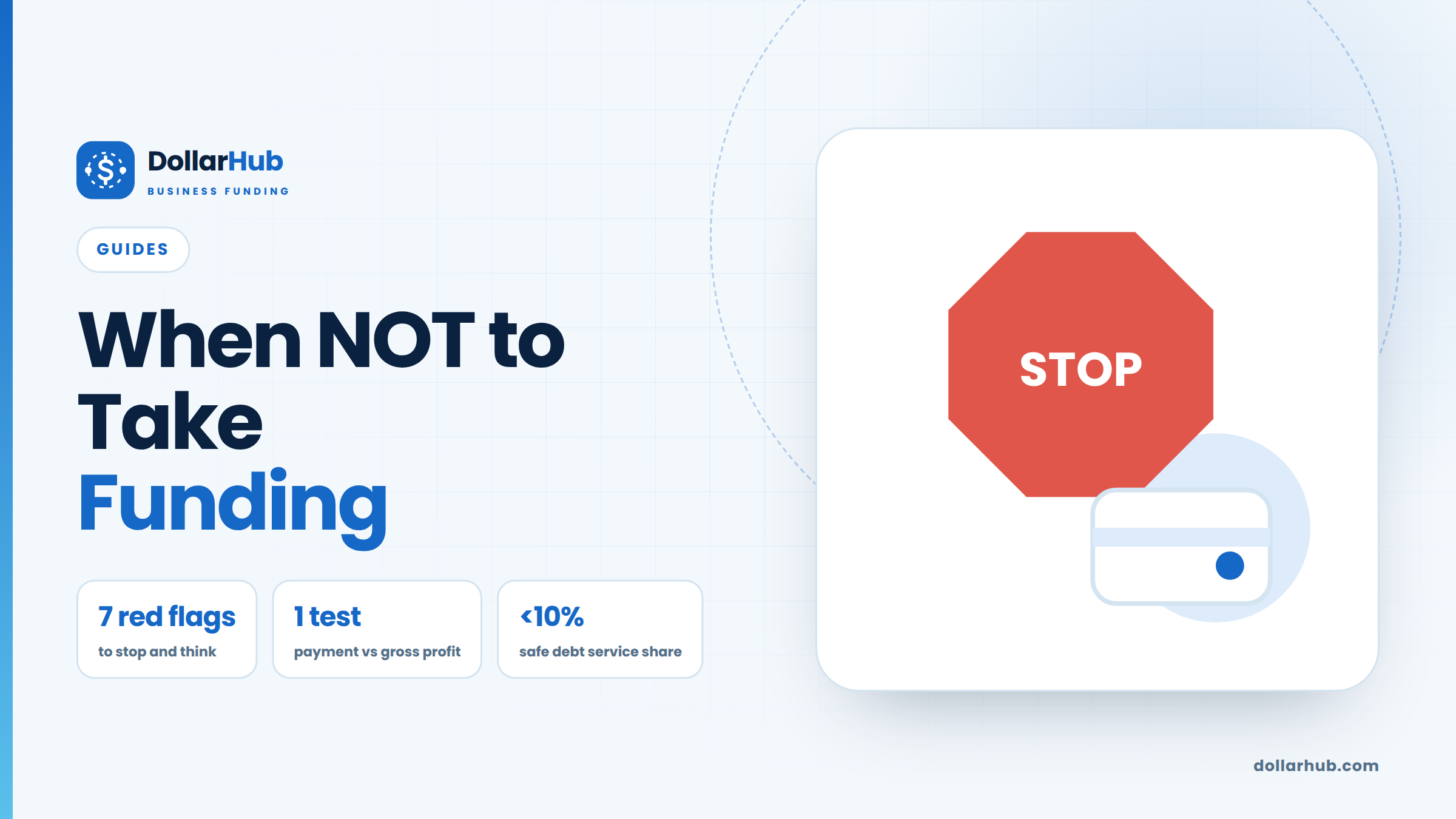
Capital solves a timing problem. It does not solve a margin problem. Seven moments when the right answer is no — and what to do instead.